
Since 2021, Switzerland has operated the world's first WHO Biohub laboratory: the Spiez Laboratory in the Bernese Oberland, officially a hub for the rapid exchange of information on emerging pathogens with epidemic or pandemic potential. This is stated so proudly on its own website, hardly debated – Parliament has been largely unaware of it for years, the Federal Council maintains a substantial silence on inquiries, and the laboratory continues to expand.
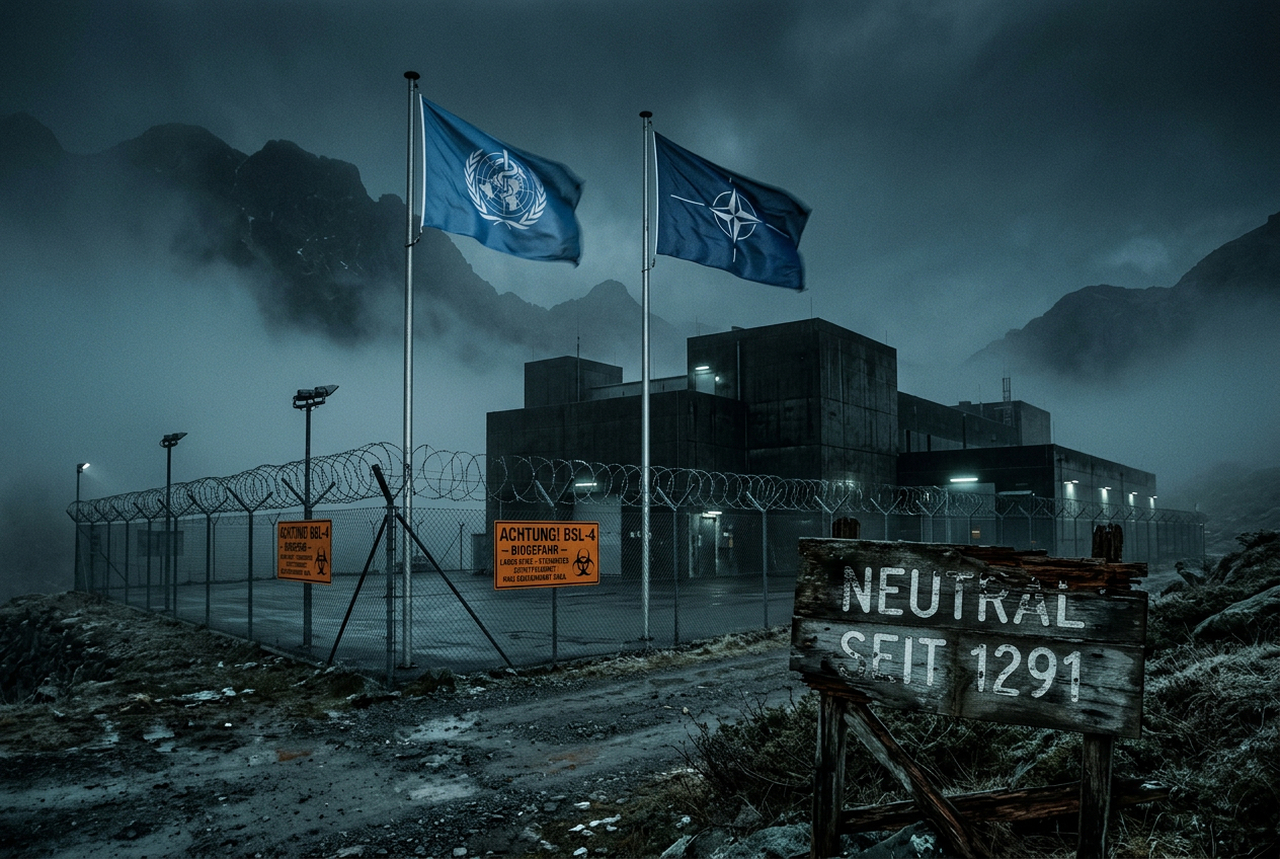
On January 13, 2026, toxicologist and immunologist Prof. Dr. Stefan Hockertz and Christian Oesch, president of the WIR association, sent a formal letter to all seven members of the Federal Council. They made five specific demands: disclosure of the legal basis for WHO activities in Spiez, a constitutional review, suspension of dual-use programs, restoration of parliamentary oversight, and active defense of Swiss neutrality. To date, no substantive response has been received. Hockertz and Oesch's questions were discussed on the political talk show Hoch2TV – one of the few platforms where this topic is even being addressed.
The MOU feat
The agreement between the Spiez Laboratory and the WHO was not concluded as a formal treaty requiring mandatory approval by the National Council and the Council of States. Instead, a Memorandum of Understanding was chosen—an instrument below the threshold of a treaty, formally circumventing parliamentary involvement. Formally permissible, perhaps, but politically a textbook example of democratic circumvention. An institution that coordinates highly dangerous pathogens across borders does so through a circuitous route that effectively ignores the elected parliament. According to Oesch, the members of the National Council and the Council of States are largely kept in the dark regarding the Spiez issue. Furthermore, since spring 2024, NATO has operated an official office in Geneva. So much for neutrality.
When amplifying means weapon
Gain-of-function research describes the targeted modification of pathogen properties, such as increasing the transmissibility of a virus from person to person. Professor Hockertz states the consequence bluntly: Whoever enhances the properties of a highly pathogenic virus is producing a weapon, an offensive weapon, for which there is no defensive variant, because its only added value is the selective harm of other people. The dual-use argument, the standard tactic used to reassure the public, fails completely here.
Whether such research is being conducted or has been conducted at the Spiez Laboratory is not publicly documented. The federal government rejects related inquiries. In May 2025, the USA issued a clear ban on funding certain forms of this research, including research conducted abroad. Switzerland is practically ignoring the debate. What is not discussed officially does not exist – a procedure the Swiss Confederation has applied with sovereign self-assurance for decades.
Third-party funding in the dark
The 2024 annual report of the Spiez Laboratory confirms the receipt of third-party funding, meaning funds from external clients whose identities and the scope of their work are not publicly available. He who pays the piper calls the tune: a principle as old as contract research itself. Which companies, which state or private institutions are behind these funds remains shrouded in mystery. Parliamentary inquiries have yielded no satisfactory answers. The WHO itself is over 80% funded by private donors, including large foundations with clear economic interests. This doesn't suggest a conspiracy theory, but rather a straightforward conflict of interest analysis: a state-run Swiss laboratory coordinates the global exchange of pathogens on behalf of a privately funded global agency, and no one asks whose interests are being served.
Ukrainian experts in a neutral biological laboratory
Publicly available sources, including an article in Weltwoche and press releases from the Ukrainian embassy, document visits by Ukrainian experts to the Spiez laboratory. Ukraine is a party to the war. Switzerland claims neutrality. The purpose of these visits, what was discussed or agreed upon, and whether comparable contacts exist with other parties to the conflict are unknown. Professor Hockertz points out that around 18 Ukrainian biological laboratories were deliberately bombed at the beginning of the war. Anyone looking for a replacement apparently finds it in a quiet, discreet country that allows research to proceed diligently because no one is asking questions.
New building, Rheinmetall and the next stage
A new laboratory building is planned, the budget has been approved, and construction is underway. Hundreds of millions of Swiss francs are flowing into the Spiez region, just 300 meters from Nitrochemie, a subsidiary of Rheinmetall. What is being created there in secret resembles an international arms biotechnology center without democratic oversight. Hockertz himself initiated the discussion about a possible upgrade to BSL5 pathogens, exceeding the highest biosafety level beyond Ebola and similar diseases. Parliament was not informed because no mechanism exists that would even require it to be notified.
This is not an administrative blunder. It is the structural reflection of a Switzerland that is gradually ceding its political sovereignty to international institutions and private third-party funders, and consistently leaving the simplest democratic question that a state governed by the rule of law must ask unanswered: Whose mandate is this laboratory carrying out, who is monitoring it, and who is liable if something goes wrong?
In business terms, silence is considered consent – and anyone who distributes pathogens around the globe on behalf of unknown third-party funders, erects a new building in the shadow of Rheinmetall, and guides Ukrainian warring parties through security checkpoints has long since forfeited any claim to the label of "neutral protective laboratory" and yet still calls it a "pioneering role"! The Biological Weapons Convention prohibits the development of biological weapons – a Memorandum of Understanding, of course, is of no interest to them, because no parliament ever knew about it! And if every amplification of a virus produces a weapon, one has to wonder what Switzerland is actually protecting in Spiez – the population or the interests of those who quietly pay up and just as quietly refuse to answer the questions!
More for you:






 "Dravens Tales from the Crypt" has been enchanting for over 15 years with a tasteless mixture of humor, serious journalism - for current events and unbalanced reporting in the press politics - and zombies, garnished with lots of art, entertainment and punk rock. Draven has turned his hobby into a popular brand that cannot be classified.
My blog was never designed to spread news, let alone get political, but with current affairs I just can't help but capture information here that is otherwise censored on all other channels. I am aware that the design page may not seem "serious" to many in this regard, but I will not change this to please the "mainstream". Anyone who is open to non-state-compliant information sees the content and not the packaging. I've tried enough to provide people with information over the last 2 years, but quickly noticed that it never matters how it's "packaged", but what the other person's attitude towards it is. I don't want to put honey on anyone's mouth to meet expectations in any way, so I'll keep this design because hopefully at some point I'll be able to stop making these political statements, because it's not my goal to go on like this forever  I leave it up to everyone how they deal with it. However, you are welcome to simply copy and distribute the content, my blog has always been under the WTFPL license.
It's hard for me to describe what I'm actually doing here, DravensTales has become a culture blog, music blog, shock blog, tech blog, horror blog, fun blog, a blog about found items on the internet, internet bizarre, trash blog, art blog, water heater, zeitgeist blog over the years , Scrap blog and grab bag blog called. Everything that is right ... - and yet not. The main focus of the blog is contemporary art, in the broadest sense of the word.
To ensure the continued operation of this site, you are welcome to make a donation via credit card, PayPal, Google Pay, Apple Pay, or direct debit/bank account . Many thanks to all readers and supporters of this blog!








