You did nothing wrong. And that's precisely your problem starting in 2027. A data center that's never seen you compares your transactions to a profile you're never allowed to see. If something doesn't match, your payment is stopped, your bank interrogates you about your profession, assets, origin, and intentions, and if your answers don't suit the clerk, you're kicked out of the payment system. No judge, no explanation. With its anti-money laundering regulation 2024/1624, the EUdSSR has turned every bank into an extension of the security apparatus, planned in Paris without a single voter, rubber-stamped in Bern, just in time for the next inspection. This isn't a fight against money laundering; it's a social credit system with bank counters, and you're already on the list.

The algorithm as confessor
From July 10, 2027, the regulation will apply directly in all 27 member states; no national parliament will be allowed to change a single comma. Article 19 turns every transaction exceeding €10,000 into an interrogation, while Article 20 mandates the continuous, seamless monitoring of every business relationship and the constant comparison of all payments with what the bank believes it knows about your profession and risk profile. Article 25 dictates the questions to be asked: purpose and economic motive, estimated amount of planned activities, origin of the funds, intended use of the funds, and the customer's occupation. Questions that previously only a public prosecutor with a search warrant could ask are now posed by the branch during a standing order.
If the computer raises an alarm, the enhanced measures outlined in Article 34 kick in: disclosure of the origin of all your assets, justification of every single transaction, and approval from senior management as to whether they will even tolerate you as a customer anymore. For those who don't comply, Article 21 stipulates termination of the business relationship. The justification is documented, but exclusively for the regulators; you will never see it. This is the rule of law in 2027: accused by the algorithm, convicted by the bank employee, and access to files restricted to the state. Just how little cash will protect you from this is stipulated in the cash limit of the same regulation.
Terror suspicion starting with small change
In January, the German financial regulator followed up. In its 2026 focus risks report , BaFin explained that terrorist funds often originate from legal sources such as salaries or donations, and that banks have so far insufficiently considered this risk. The solution: a review of the intended use of funds for every transaction and a press review of the customer before every new business relationship. In other words: your salary is suspicious, your donation is suspicious, your five-franc contribution to your favorite blog is suspicious, and whether you even get an account depends, in part, on what the newspaper has written about you.
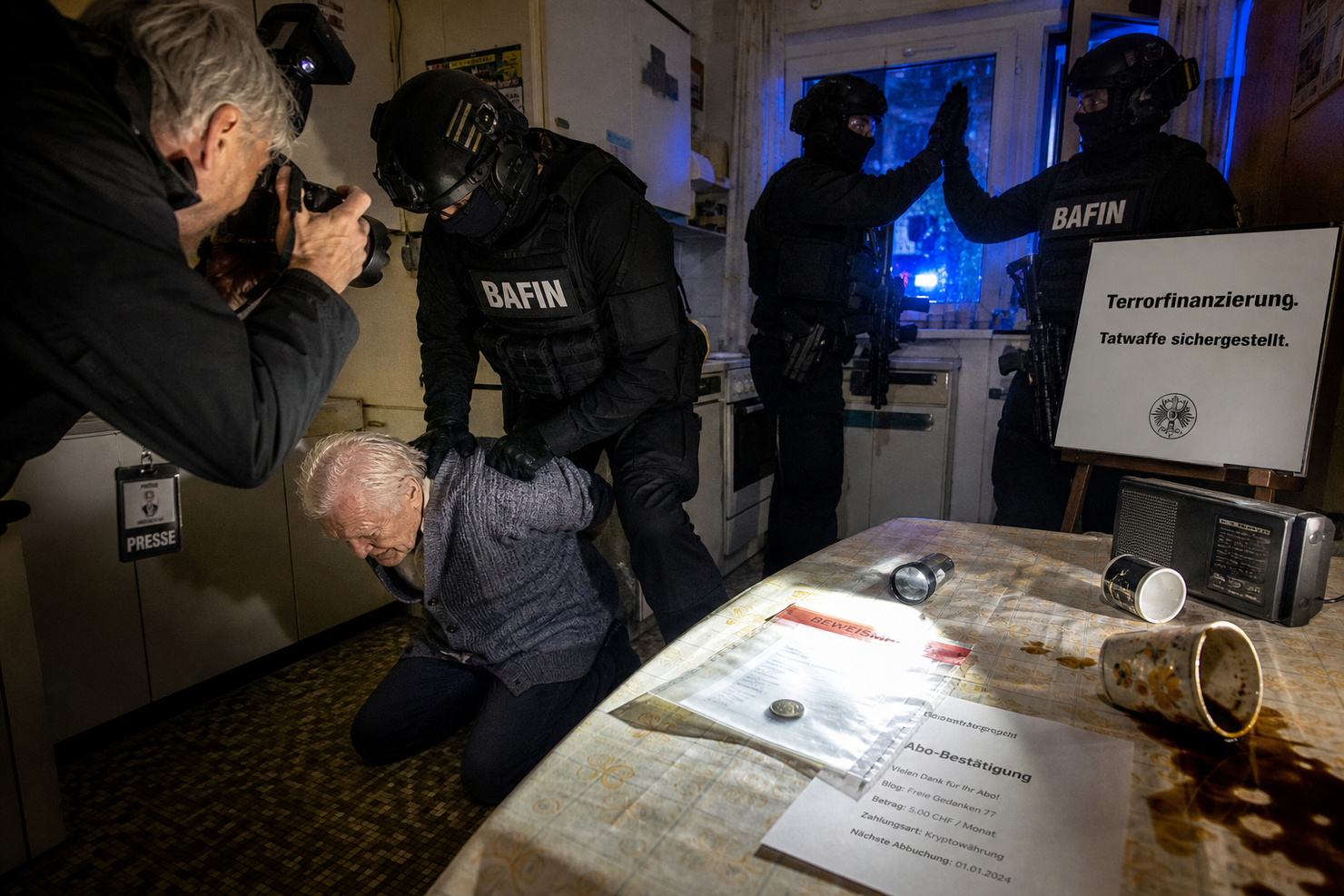
The FATF report on crowdfunding from 2023 reveals the source of this delusion. It identifies subscription models, small donations, and tipping functions on video platforms as financing channels for extremism. Risk factors include anti-vaxxers, hostility towards authority, and "various conspiracy theories." The report itself acknowledges that much of this is legal and even protected by fundamental rights in some countries. Annex III of the EU regulation takes care of the rest, classifying payments from unknown third parties and new business models as high-risk. An independent media outlet that relies on numerous small contributions is thus legally classified as a terrorist cell, and each of its readers as a terrorist financier. The gag is no longer imposed by the state , but by the local bank.
The government is governed in Paris, but the money is collected in Frankfurt.
This logic originates from the Financial Action Task Force (FATF), a cartel of security agencies and banking supervisors that officially describes its 40 recommendations as non-binding while simultaneously urging all countries to implement them effectively , using regular country reviews as a form of enforcement. Switzerland, as a member, sits at the table and nods in agreement.
Enforcement takes place from Frankfurt. AMLA is slated to grow to around 450 officers by the end of 2027 , is financed three-quarters by fees from the supervised banks, and is authorized to conduct unannounced searches of business premises, inspect IT systems and algorithmic decision-making processes, and publicly shame institutions. Torture with a bill for the tortured.
Anyone who thinks they can simply transfer their money to a bank outside the EU is in for a rude awakening. From January 11, 2027, banks in third countries without an authorized EU branch will no longer be permitted to provide core banking services to EU citizens. Those who approach banks directly will still be able to receive services, but the bank must report every such relationship to the regulatory authorities.
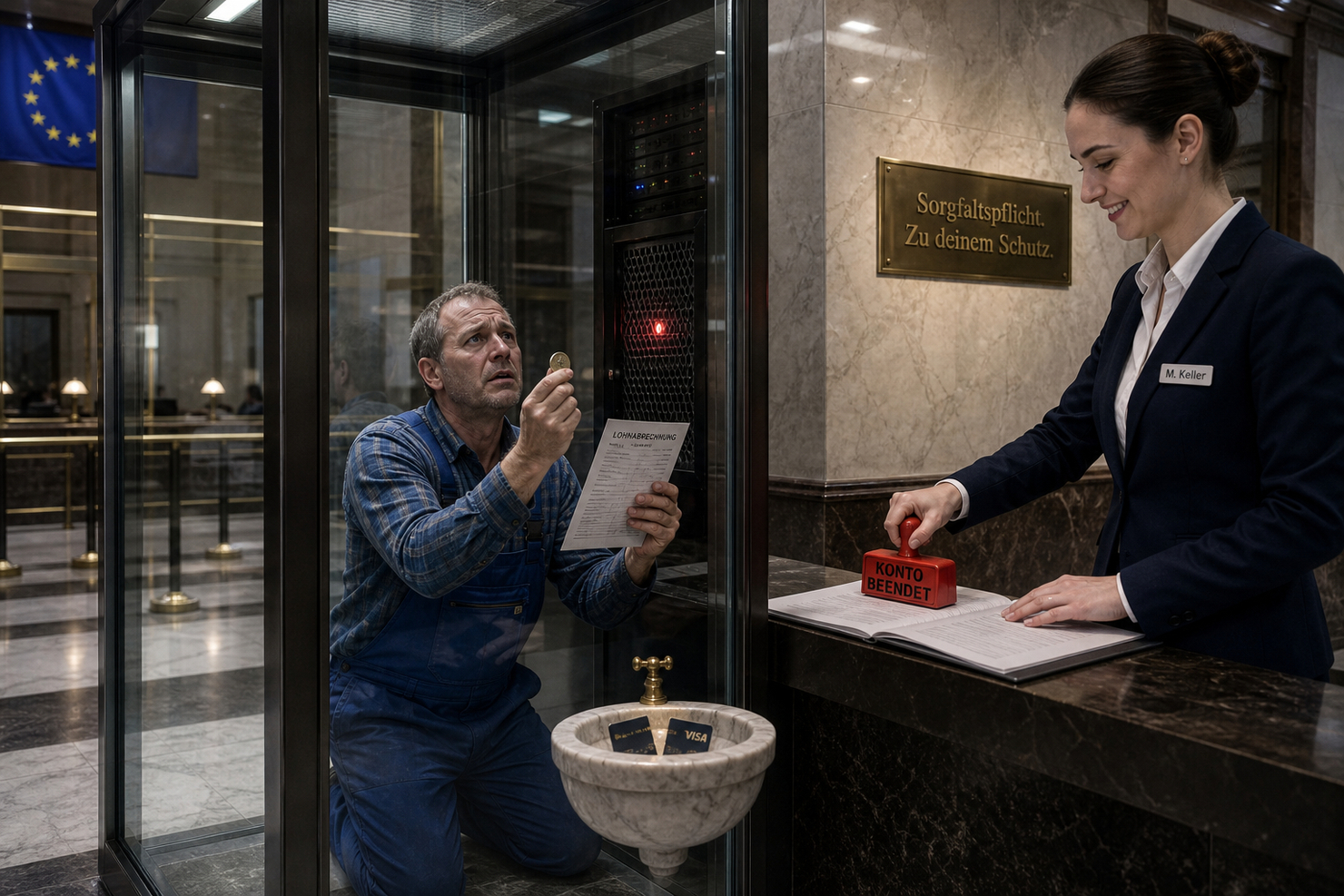
And Bern? The Federal Council will bring the revised money laundering law, including the transparency register, into force on October 1, 2026 , justifying the timeline in October 2025 with disarming candor: this ensures that the measures can be taken into account in the next FATF country review . Parliament approved it by a vote of 116 to 75 , despite opposition from the Swiss People's Party (SVP) . You already know how voluntary all of this is from the e-ID.
Beijing set the example, Brussels calls it diligence
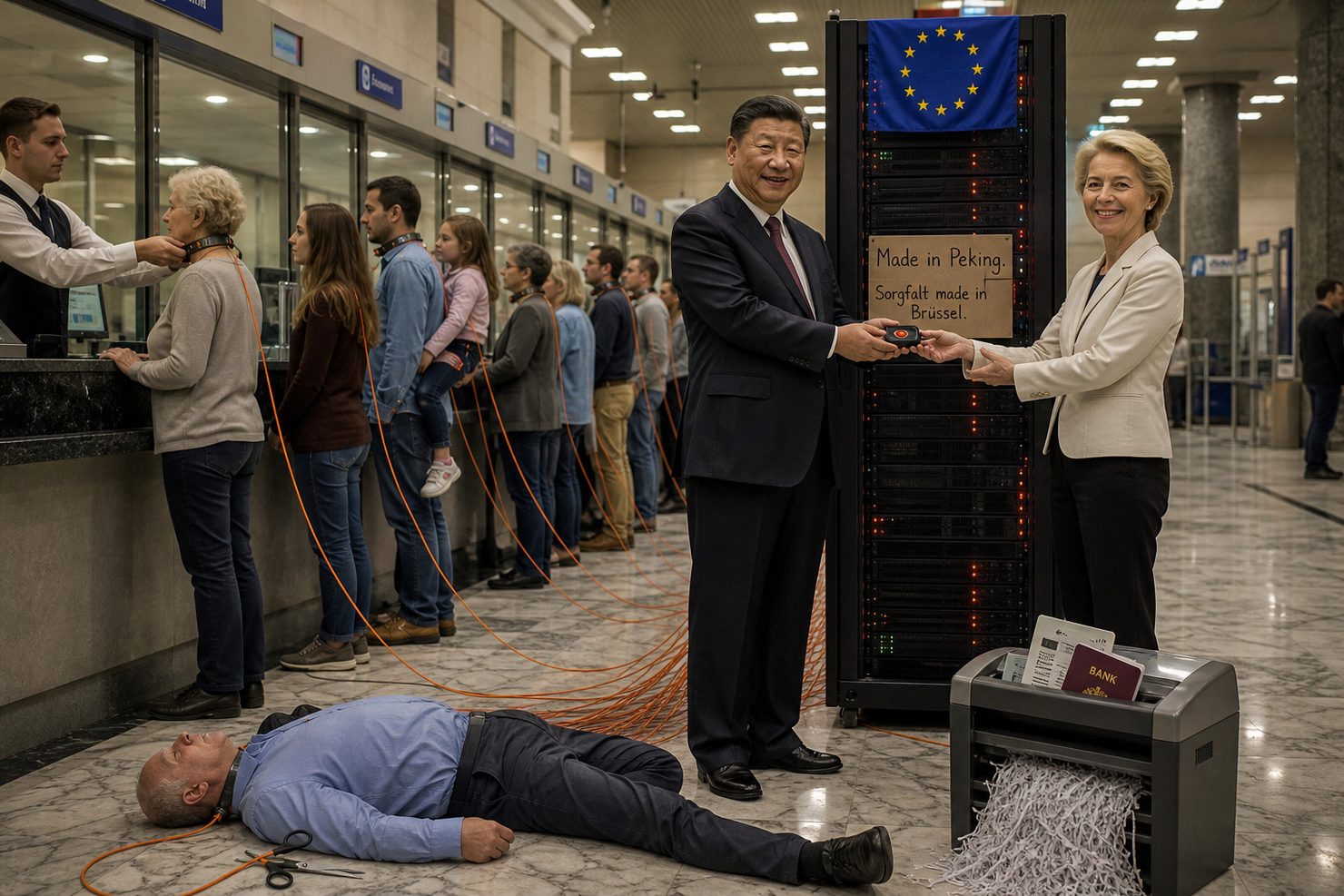
In 2014, China's State Council described the mechanism of its social credit system in a single sentence: rewards for the trustworthy, restrictions for the unreliable. This is precisely what's now enshrined in Brussels as a regulation, only without the word "trustworthy" and with improved software. The trustworthy transfer money without interference, the unreliable are questioned, detained, reported, and ultimately removed from the payment system. Whether you're considered unreliable is determined by a risk profile you never see, based on your subscriptions, donations, and the headlines about you. Whoever controls the interpretation of how the money is used no longer needs censorship; they simply cut off the payment flow. The collar is ready ; the digital euro will provide the leash.
No terrorist will be stopped by this system, because they don't transfer their money via standing order with a specific purpose. What is stopped is the citizen who buys the wrong books, subscribes to the wrong blogs, and withdraws cash too often. The FATF calls it standard practice, Frankfurt calls it oversight, Bern calls it a country-specific audit, and you're free to dispose of your money as soon as an algorithm has determined your motive. On top of that, your bank fees pay the rent for the confessional. The EUdSSR imported the social credit system from Beijing, outsourced it to bank counters, and calls this "due diligence"!
More for you:






 "Dravens Tales from the Crypt" has been enchanting for over 15 years with a tasteless mixture of humor, serious journalism - for current events and unbalanced reporting in the press politics - and zombies, garnished with lots of art, entertainment and punk rock. Draven has turned his hobby into a popular brand that cannot be classified.
My blog was never designed to spread news, let alone get political, but with current affairs I just can't help but capture information here that is otherwise censored on all other channels. I am aware that the design page may not seem "serious" to many in this regard, but I will not change this to please the "mainstream". Anyone who is open to non-state-compliant information sees the content and not the packaging. I've tried enough to provide people with information over the last 2 years, but quickly noticed that it never matters how it's "packaged", but what the other person's attitude towards it is. I don't want to put honey on anyone's mouth to meet expectations in any way, so I'll keep this design because hopefully at some point I'll be able to stop making these political statements, because it's not my goal to go on like this forever  I leave it up to everyone how they deal with it. However, you are welcome to simply copy and distribute the content, my blog has always been under the WTFPL license.
It's hard for me to describe what I'm actually doing here, DravensTales has become a culture blog, music blog, shock blog, tech blog, horror blog, fun blog, a blog about found items on the internet, internet bizarre, trash blog, art blog, water heater, zeitgeist blog over the years , Scrap blog and grab bag blog called. Everything that is right ... - and yet not. The main focus of the blog is contemporary art, in the broadest sense of the word.
To ensure the continued operation of this site, you are welcome to make a donation via credit card, PayPal, Google Pay, Apple Pay, or direct debit/bank account . Many thanks to all readers and supporters of this blog!